
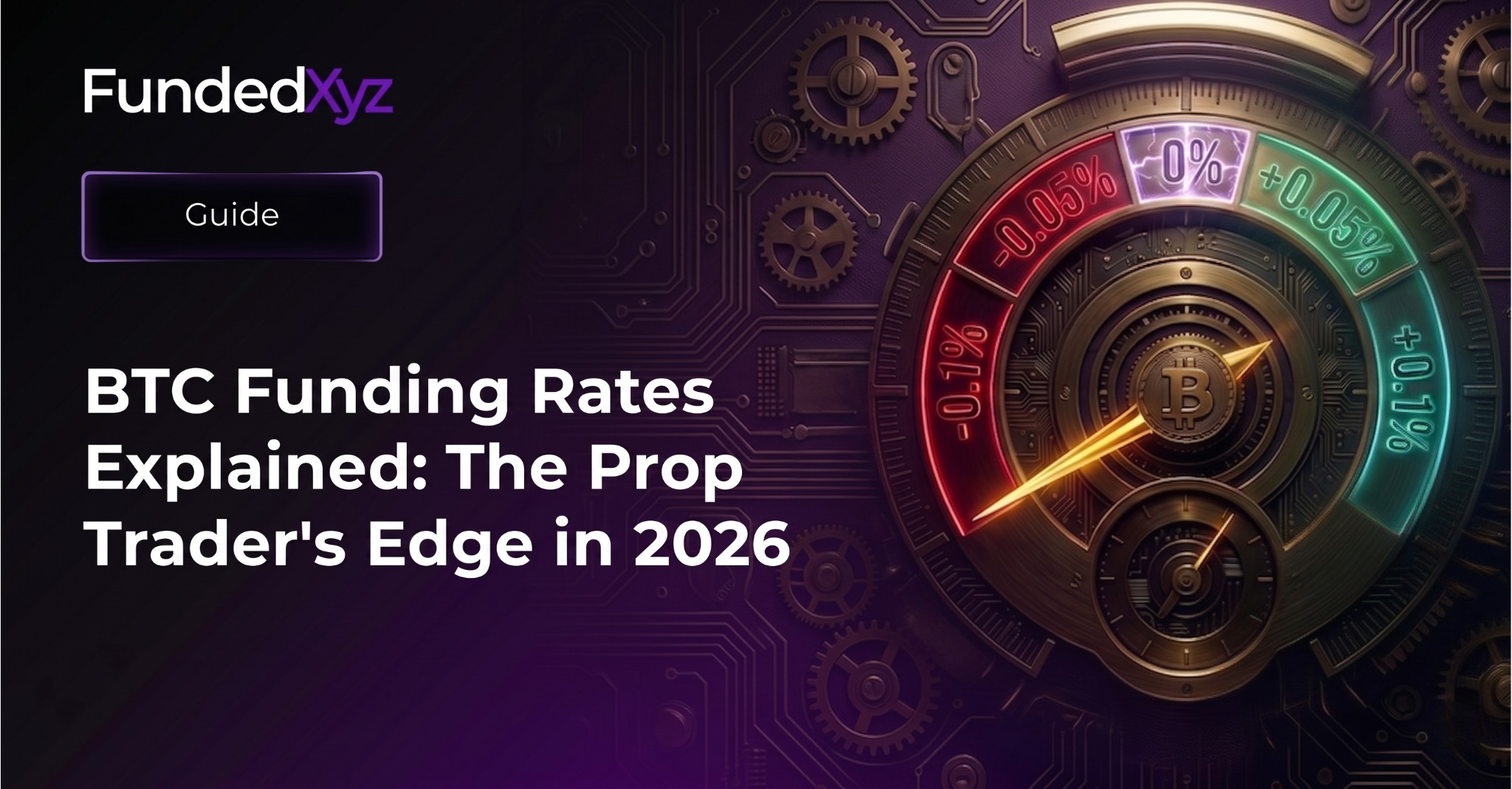
BTC funding rates are one of the most overlooked edges in crypto prop trading — yet they predicted every major short squeeze in 2025 and 2026. If you're trading a funded account, reading funding rates correctly can be the difference between a disciplined, high-probability entry and getting liquidated on the wrong side of a 10% move. This guide covers everything: what funding rates are, how to read them, and how prop traders use them to structure their best setups.
What Are BTC Funding Rates?
Funding rates are periodic payments exchanged between long and short traders on perpetual futures exchanges (Binance, Bybit, OKX, etc.). Unlike traditional futures, perpetual contracts have no expiry — so funding rates keep the contract price anchored to spot.
Every 8 hours (on most exchanges):
- When funding is positive: longs pay shorts. The market is bullish-leaning.
- When funding is negative: shorts pay longs. The market is bearish-leaning.
The rate itself is usually tiny (0.01% per 8 hours = 0.03% per day), but the direction and magnitude tell you everything about market sentiment and who is over-extended.
How Funding Rates Work on Perpetual Futures
Perpetual futures don't settle — they can be held indefinitely. To prevent the perp price from diverging far from spot, exchanges use the funding mechanism:
- If perp > spot: rate goes positive → longs pay shorts → pressure to sell perp / buy spot
- If perp < spot: rate goes negative → shorts pay longs → pressure to buy perp / sell spot
This arbitrage keeps the gap small. But when sentiment is extreme, funding can stay elevated (or deeply negative) for days or weeks — and that's when the big moves happen.
Negative vs Positive: What Each Signals
Positive Funding (Market Is Long-Heavy)
When funding stays consistently positive above 0.05%+, the market is crowded with longs. This creates:
- Risk of a long liquidation cascade on a sudden dip
- "Sell the news" setups after major positive catalysts
- Caution for new long entries — you're trading with the crowd
Negative Funding (Market Is Short-Heavy)
This is the more powerful signal for prop traders. Deeply negative funding (below -0.03%) with a sideways or rising price means:
- Shorts are paying longs to hold their position
- Bears are getting increasingly painful — the fuel for a squeeze
- Any bullish catalyst can trigger rapid short covering = explosive moves up
In April 2026, BTC saw 47 consecutive days of negative funding while price held above $75K. When spot demand returned, the market squeezed 10%+ in 24 hours. Prop traders who read this setup correctly had a low-risk, high-reward long entry ready.
How to Spot a Short Squeeze Setup
Not every negative funding period produces a squeeze. Here's the full checklist:
- Funding deeply negative for 7+ days — the longer, the more painful for shorts
- Price holding above key support — bears can't push it lower despite the crowding
- Open interest not collapsing — shorts are adding, not closing
- Spot premium near zero or negative — institutional demand is flat (but can spike)
- A catalyst approaching — macro event, ETF flow data, Fed decision
When all five align, you have a textbook squeeze setup. The trade: long on a confirmed breakout above the range high, with a stop below the last swing low.
Using Funding Rates in a Prop Firm Account
When trading a funded account at FundedXYZ or similar firms, funding rate analysis helps you:
1. Avoid Low-Probability Longs in Crowded Markets
If funding is extremely positive and price is near resistance, the risk/reward for a long is poor. Smart prop traders wait for the flush or find a better entry on the other side.
2. Size Into Squeeze Setups With Confidence
With a 5% daily drawdown limit and a max 10% overall drawdown, prop traders can't afford to be wrong often. A high-conviction short squeeze setup — negative funding + support hold + catalyst — lets you size closer to your max risk per trade because the edge is real.
3. Hold Through the Noise
One of the hardest parts of prop trading is holding winners. When funding data confirms the squeeze is still in play (shorts still paying, price still rising), you have a quantitative reason to hold your position instead of taking early profits.
4. Don't Chase
Once funding flips positive after a squeeze, the trade is largely over. Many prop traders fail by entering after the catalyst, when the crowd is already long and funding is spiking. Wait for the next reset.
Best Tools for Tracking BTC Funding Rates
- Coinglass.com — Best aggregated view of funding rates across all major exchanges, with historical charts
- Bybit / Binance dashboards — Live funding for the exchanges you trade on
- CryptoQuant — On-chain + derivatives data combined; useful for open interest + funding correlation
- Glassnode — Deeper OI and liquidation heatmap data (paid tier)
- Velo Data — Institutional-grade cross-exchange funding aggregation
Most prop traders use Coinglass for a quick daily scan and set alerts when funding crosses -0.05% or +0.05% on any major exchange.
Common Mistakes Traders Make With Funding Rates
Mistake 1: Treating Negative Funding as an Immediate Buy Signal
Funding can stay negative for months while price keeps grinding lower. You need the full setup — especially price holding support — before entering.
Mistake 2: Ignoring Exchange Differences
Funding on Bybit can be -0.1% while Binance shows -0.02%. This divergence itself is a signal — it tells you where the crowded shorts are concentrated.
Mistake 3: Forgetting the Carry Cost
If you're trading a long in a negative funding environment, you're being paid a small amount every 8 hours. If you're short in a negative funding environment, you're paying. Over weeks, this can meaningfully affect your P&L — especially relevant when sizing positions in a prop challenge.
Mistake 4: Using Funding in Isolation
Funding rates are one signal. Combine them with: spot order flow, OI trends, macro context (Fed meetings, CPI prints), and key technical levels for a complete picture.
Frequently Asked Questions
What does -0.1% funding rate mean?
It means short traders are paying 0.1% every 8 hours to maintain their positions — that's 0.3% per day. If funding stays there for 30 days, shorts have paid 9% just in carry costs. This pain eventually forces them to close, creating a squeeze.
Can I use funding rate data in FundedXYZ challenge accounts?
Yes. FundedXYZ doesn't restrict your analysis methods — you can use any data source. What matters is that your trades stay within the drawdown and position sizing rules. Using funding rate analysis to find better entries actually makes it easier to comply with those rules.
How often do funding rates update?
Most major exchanges settle funding every 8 hours (00:00, 08:00, 16:00 UTC). Some newer exchanges use 4-hour or even 1-hour intervals. Always check your specific exchange.
Is negative funding more reliable on BTC than altcoins?
Yes. BTC has deeper liquidity and more institutional participation, so its funding rate signals are generally cleaner. Altcoin funding can be distorted by thin order books and single-actor manipulation. Start with BTC.
Bottom line: Funding rates are free data that most retail traders ignore. For prop traders operating with defined risk limits, they provide a systematic edge for identifying when the crowd is wrong and a squeeze is building. Add funding rate analysis to your pre-trade checklist and you'll find yourself entering with the wind at your back more often than not. Ready to put it to work? Start your FundedXYZ challenge today.